
A New Vision for Health, Prevention, and Quality of Life
For decades, healthcare systems around the world have focused primarily on one goal: treating illness after it appears.
Today, a different conversation is emerging. Instead of asking how to treat disease, policymakers, researchers, and healthcare leaders are increasingly asking a new question:
How can people remain healthy, active, and independent for longer?
This shift is driving the global longevity movement. This field combines preventive healthcare, lifestyle medicine, biotechnology, regenerative medicine, artificial intelligence, and public health initiatives to extend not only lifespan but, more importantly, healthspan.
Healthspan refers to the number of years people can enjoy good health, vitality, and quality of life.
The Lessons from the World’s Longest-Living Communities
The discussion around longevity gained worldwide attention through the research on the so-called Blue Zones—regions where people consistently live longer and healthier lives than average.
These communities, located in places such as Okinawa, Sardinia, and Nicoya, revealed an important insight: longevity is rarely the result of healthcare alone.
Researchers found that several factors contributed to healthier and longer lives:
Strong social relationships
A clear sense of purpose
Daily physical activity
Balanced nutrition
Community engagement
Low levels of chronic stress
Supportive living environments
The findings challenged a common assumption. Living longer is not solely determined by medical treatment. It is also shaped by the environment people live in every day.
From Blue Zones to Smart Cities
In recent years, several governments have begun exploring how entire cities can be designed to support healthier populations.
Singapore is often cited as a leading example. Through strategic urban planning, accessible healthcare, public wellness initiatives, and investments in innovation, the city-state has become one of the world’s most admired health-focused societies.
The concept is simple but ambitious: create an environment that makes healthy choices easier and more accessible.
Now, a growing number of cities are pursuing similar goals.
Dubai’s Growing Focus on Longevity
Dubai has long been known for its rapid development, innovation, and ambitious vision for the future.
Today, healthcare is becoming an increasingly important part of that vision.
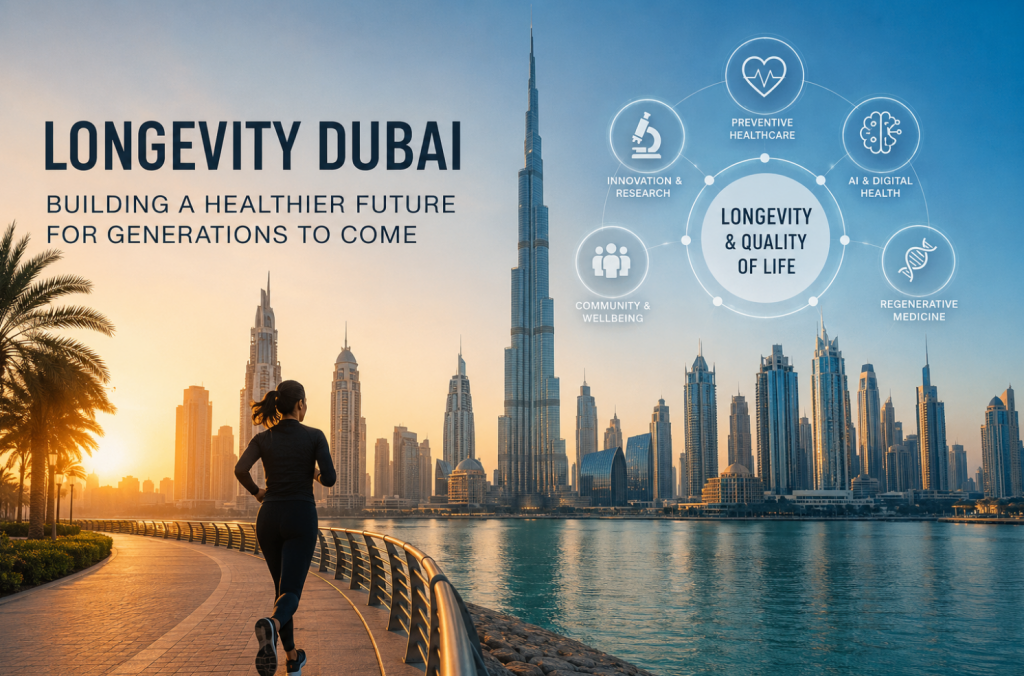
Recent initiatives and investments demonstrate a strong commitment to preventive healthcare, medical innovation, life sciences, digital health technologies, and research-driven healthcare solutions.
The establishment of the Dubai Longevity Authority reflects a broader recognition that future healthcare systems must focus not only on treating illness but also on improving long-term wellbeing and quality of life.
While longevity remains a relatively young field globally, Dubai appears determined to become an important contributor to its development.
What This Means for Healthcare Professionals
For doctors, dentists, specialists, therapists, researchers, and healthcare entrepreneurs, the growing emphasis on longevity opens new opportunities.
Several healthcare disciplines are becoming increasingly relevant:
Preventive Medicine
Regenerative Medicine
Precision Medicine
Health Optimisation
Functional and Lifestyle
Medicine
Advanced Diagnostics
Digital Health and AI-supported Care
As healthcare evolves, professionals who understand these emerging fields may play a significant role in shaping the next generation of patient care.
Beyond Medicine
Perhaps the most interesting aspect of the longevity discussion is that it extends beyond hospitals and clinics.
A healthy society is influenced by education, infrastructure, community design, technology, nutrition, environmental quality, and social connection.
Longevity is not simply about adding years to life.
It is about creating the conditions that allow people to remain physically healthy, mentally resilient, socially connected, and professionally active for as long as possible.
The Future of Healthy Living
The global longevity movement is still in its early stages, but its influence is growing rapidly.
As populations age and healthcare systems face increasing pressure, the focus is gradually shifting from reactive medicine toward prevention, optimisation, and sustainable wellbeing.
Whether Dubai ultimately becomes a global longevity hub remains to be seen.
What is already clear, however, is that the conversation has begun—and it is changing the way governments, healthcare professionals, and individuals think about health, ageing, and the future of human potential.
