
A transport failure or a warning sign for Europe?
When Infrastructure Stops, Economies Slow Down
On the evening of June 23, Germany experienced yet another large-scale disruption to its rail network. A nationwide failure of the digital railway communication system brought train traffic across the country to a standstill. The outage stranded thousands of passengers, overwhelmed train stations, and brought major transportation corridors to a temporary standstill.
For many observers, this was not simply another technical malfunction.
It was another visible symptom of a broader challenge facing Europe: aging infrastructure, increasing bureaucracy, delayed modernization, and growing pressure on public systems.
The railway incident is only the latest in a series of disruptions affecting Europe’s largest economy. Over recent years, Germany has faced repeated challenges involving transportation networks, energy supply, digital infrastructure, public administration, housing shortages, and declining industrial competitiveness. While the country remains one of the world’s strongest economies, many citizens increasingly question whether the speed of modernization is keeping pace with global competition.
The Bigger Question
The issue is not whether technical failures happen.
Every country experiences unexpected outages.
The real question is how often they happen, how quickly they are resolved, and whether the underlying systems are prepared for the future.
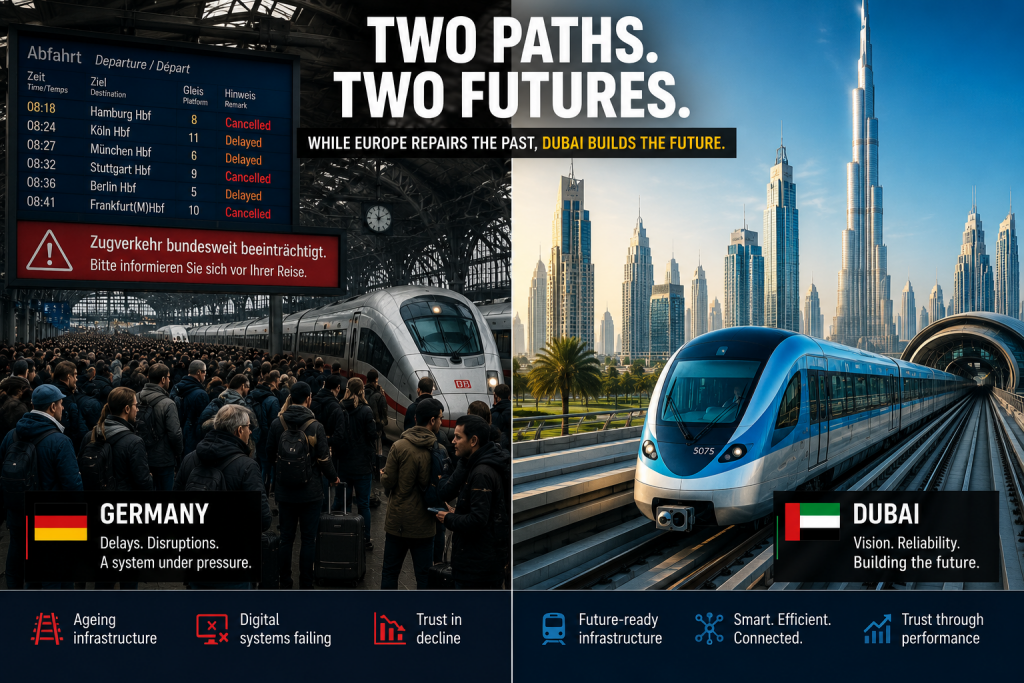
Across Europe, governments are now investing billions into infrastructure upgrades, railway modernization, digital transformation, and energy transition projects. Yet many of these initiatives require years to implement, while citizens experience the consequences today.
The railway shutdown became symbolic because it touched something fundamental.
Trust that trains arrive on time.
Confidence in functioning systems.
Reliance on dependable infrastructure.
The expectation that essential services will be there when needed.
When that trust is repeatedly challenged, confidence in institutions begins to erode.
Meanwhile Dubai is Building the Future
While many mature economies are investing heavily to repair aging infrastructure, Dubai has spent the last two decades building much of its infrastructure from the ground up.
The result is visible.
Road networks continue expanding.
Airports continue growing.
Digital government services operate largely online.
Business licenses can often be established within days rather than months.
Major infrastructure projects are launched with long-term strategic planning in mind.
Dubai’s approach differs in one important way:
Instead of focusing primarily on maintaining legacy systems, it focuses on building future-ready systems.
That distinction matters.
For entrepreneurs, investors, doctors, consultants, and business owners, reliability has become a competitive advantage.
The ability to open a company quickly, obtain government services digitally, access world-class airports, and operate within a highly connected ecosystem creates an environment where growth becomes easier.
A Shift in Global Economic Gravity
The global economic landscape is changing.
For decades, Europe represented stability, industrial strength, and economic opportunity.
Today, many professionals are looking elsewhere for growth.
The Middle East, particularly Dubai and the UAE, has positioned itself as one of the world’s most attractive destinations for entrepreneurs, skilled professionals, family offices, investors, and international businesses.
This is not happening by accident.
It is the result of long-term planning, infrastructure investment, business-friendly regulation, and a clear vision for economic diversification.
While parts of Europe are discussing how to modernize systems built decades ago, Dubai is increasingly discussing artificial intelligence, smart mobility, longevity, space technology, advanced healthcare, and global talent attraction.
The Lesson Behind the Headlines
Germany’s railway disruption is not the story.
The real story is what it represents.
Infrastructure is more than concrete, steel, tracks, and technology.
It reflects a nation’s ability to execute.
And in a world where talent and capital can move faster than ever before, execution increasingly determines competitiveness.
For many international professionals, the question is no longer:
“Where have opportunities existed in the past?”
The question is:
“Where are opportunities being built for the future?”
More and more often, the answer includes Dubai.
Company Description
Deutsche Bahn is Germany’s national railway and logistics company and one of the largest transportation providers in Europe. Headquartered in Berlin, Deutsche Bahn is wholly owned by the German government and operates a significant portion of the country’s public transportation and freight logistics infrastructure.
Founded in 1994 through the merger of the former East and West German state railways, Deutsche Bahn operates an extensive network of high-speed, regional, and local passenger services, as well as international rail connections across Europe. Deutsche Bahn connects major German cities and neighboring countries through its flagship high-speed rail network, the Intercity-Express (ICE)
Beyond passenger transportation, Deutsche Bahn is a major logistics and freight operator through its subsidiaries, serving industrial, commercial, and international supply chain markets. The company manages thousands of kilometers of rail infrastructure, stations, signaling systems, and transportation assets, making it one of Europe’s most significant mobility providers.
Today, Deutsche Bahn employs hundreds of thousands of people worldwide and is actively investing in digitalization, sustainability initiatives, infrastructure modernization, and climate-friendly transportation solutions. As rail travel continues to play an important role in Europe’s mobility strategy, Deutsche Bahn remains a key pillar of Germany’s transportation network and economic infrastructure.
