
Two extraordinary celestial events
A total solar eclipse on 12 August 2026 drew global attention across parts of Europe and the North Atlantic. Hours later, the Perseids meteor shower reached its annual peak.
Timing made the combination especially compelling. A New Moon created exceptionally dark skies with almost no moonlight, giving stargazers excellent conditions to observe the Perseids overnight from 12 to 13 August.
For astronomy enthusiasts, it was an unusual double event: the Sun disappearing during the day, followed by meteors streaking across the night sky.
What Are the Perseids?
The Perseids are among the best-known annual meteor showers.
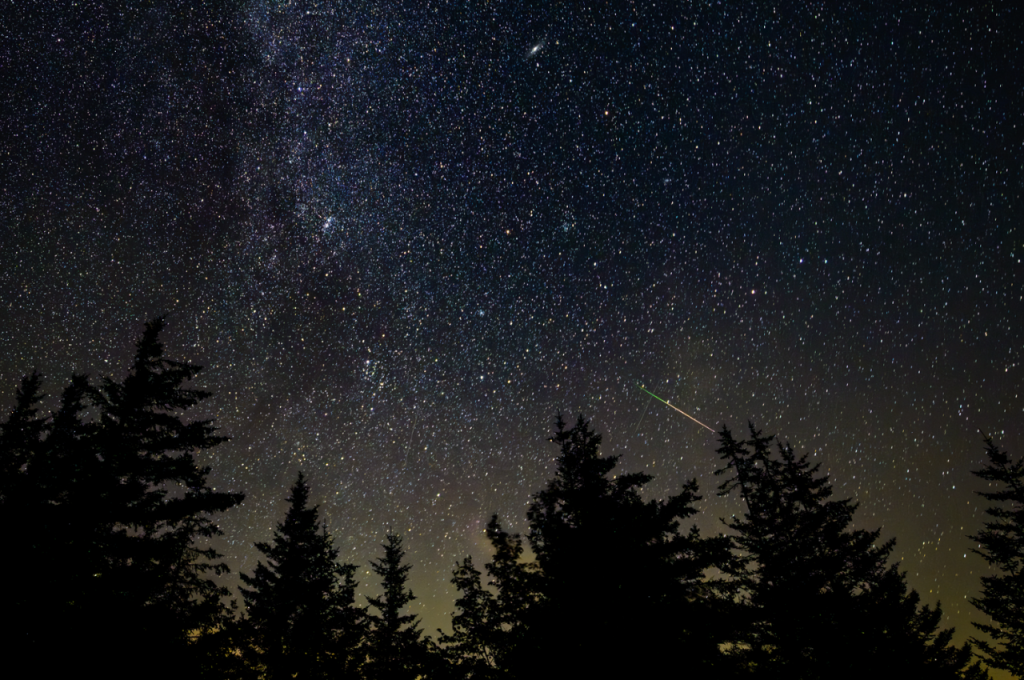
They occur when Earth passes through a trail of particles left behind by Comet 109P/Swift-Tuttle. As those particles enter Earth’s atmosphere at extremely high speeds, they heat up and create the bright streaks commonly known as shooting stars.
According to NASA’s guide to the Perseids meteor shower, the Perseids are particularly popular because they regularly produce bright meteors and occasional fireballs.
Why Are They Called the Perseids?
The name comes from the constellation Perseus.
From Earth, the meteors appear to radiate from an area of the sky close to Perseus. Astronomers call this apparent point of origin the radiant.
Perseus itself does not produce the meteors. Their real source is the debris left behind by Swift-Tuttle.
Why 2026 Was Different
The Perseids return every August, but 2026 offered unusually favourable viewing conditions.
The meteor shower peaked around the time of a New Moon, meaning there was little moonlight to obscure fainter meteors. NASA’s skywatching guide highlighted the Perseids as one of the month’s major celestial events, with the peak occurring overnight from 12 to 13 August 2026.
What made the date even more unusual was that the same New Moon also produced another major astronomical event earlier that day.
A total solar eclipse
A Solar Eclipse Just Hours Earlier
On 12 August, the Moon moved directly between Earth and the Sun.
The resulting total solar eclipse crossed parts of Greenland, Iceland, northern Russia, Spain and Portugal, while surrounding regions experienced a partial eclipse.
For observers positioned inside the path of totality, the Moon completely covered the Sun for a short period. Daylight faded, temperatures shifted, and the Sun’s normally hidden corona became visible.
According to NASA, the longest period of totality experienced from the ground reached approximately two minutes and eighteen seconds.
The European Space Agency also documented the eclipse path across Europe, including prominent viewing areas in Iceland and Spain.
Two Events, One Remarkable Date
Despite their close timing, the eclipse and the Perseids were completely separate phenomena.
The solar eclipse occurred because of the alignment of the Sun, Moon, and Earth. The Perseids occurred because Earth passed through debris left behind by Comet Swift-Tuttle.
Their connection was timing.
The New Moon required for the solar eclipse also created exceptionally dark skies for the meteor shower later that night. Together, those conditions made 12 August a particularly memorable date for skywatchers.
The UAE Could Watch the Perseids
The solar eclipse itself was not visible from the UAE, but the Perseids were.
Dark areas away from the intense light of Dubai and Abu Dhabi offered much better viewing conditions than heavily illuminated urban locations.
The Dubai Astronomy Group organised a dedicated Perseids observation event at Al Khatim Desert in Abu Dhabi from the evening of 12 August into the early hours of 13 August.
The event combined meteor watching with astronomy education and guided sky observation.
That local response takes the story beyond an international astronomy headline. It demonstrates how a global natural phenomenon can become a local experience, and potentially an economic one.
When Astronomy Becomes an Experience
People increasingly travel for moments they cannot simply recreate whenever they choose.
Meteor showers fit that behaviour particularly well. They occur at a specific time, visibility is never entirely guaranteed, and the experience of standing beneath a dark sky cannot be fully replicated through a screen.
Scarcity gives astronomical events something businesses and destinations constantly compete for: Attention.
Once attention exists, demand can follow. Accommodation, transport, guided experiences, photography, educational events and hospitality can all form part of the wider experience surrounding a celestial event.
This is where astronomy begins to intersect with the experience economy.
Dubai’s Opportunity Is Bigger Than the Skyline
Dubai is internationally associated with skyscrapers, luxury hotels and major events, but the wider UAE offers a very different landscape once the city lights begin to fade.
Open desert areas provide wider horizons and darker skies, creating natural opportunities for stargazing and astronomy experiences.
The contrast is part of the appeal.
A traveller can spend the day in one of the world’s most modern urban environments and, within the same region, spend the evening under an open desert sky watching meteors.
For a destination built around memorable and premium experiences, astronomy adds another dimension without requiring the attraction itself to be constructed.
The Rise of Astro-Tourism
Astro-tourism is moving beyond its niche beginnings and becoming part of the wider experience-led travel market.
Travellers are increasingly seeking destinations where they can witness exceptional night skies, eclipses, meteor showers and other rare celestial events.
The appeal goes beyond science. These moments are memorable precisely because they cannot be recreated on demand. People remember where they were when they saw something extraordinary.
For destinations focused on premium and experience-led tourism, that creates an interesting opportunity.
The attraction often already exists.
The value comes from making it easier to access, better to experience, and worth travelling for.
The Lesson Behind the Perseids
The Perseid meteor shower itself is free.
No company owns it, no brand created it, and no business can control when it appears.
Yet considerable value can still be built around the experience.
Transport providers can bring visitors to darker viewing locations. Hotels can develop astronomy packages. Tour operators can combine stargazing with desert experiences, while photographers, educators and astronomy experts can create workshops, guided observations and premium events.
The opportunity is not in owning the phenomenon. It is in making the experience around it more accessible, memorable and valuable.
That principle extends well beyond tourism.
Entrepreneurs often assume they need to create demand from scratch. In reality, some of the strongest opportunities begin with demand that already exists.
The challenge is recognising it early, understanding what people value, and building the right offer around it.
The Perseids are a reminder that successful businesses do not always create attention. Sometimes it’s about knowing how to create value when the attention is already there.
Why Real Experiences Are Becoming More Valuable
In a world where almost everything can be viewed instantly on a screen, physical experiences can become more valuable precisely because they cannot be fully reproduced digitally.
Watching a meteor shower online is easy.
Standing beneath a dark desert sky as a meteor crosses overhead is something entirely different.
For Dubai and the wider UAE, that distinction creates opportunity. The region already combines international connectivity, sophisticated tourism infrastructure, and demand for premium experiences.
Astronomy introduces another layer.
Nature creates the moment. Businesses can create the experience around it.
Nature creates the moment.
The business opportunity: Making it accessible, memorable, and worth travelling for.
The Perseids Are Still Active
The Perseids do not disappear immediately after their peak.
Although meteor activity gradually decreases after 12 and 13 August, NASA’s Perseid meteor shower overview lists the shower as active through 24 August 2026.
For UAE residents who missed the peak, darker desert locations may still offer opportunities to see individual Perseid meteors during the remaining activity period.
Looking Beyond the Sky
The events of 12 August 2026 brought together two very different celestial phenomena.
By day, the Moon moved across the Sun. By night, the Perseids appeared as Earth travelled through ancient comet debris.
The science was extraordinary, but the human response was equally revealing.
People travelled, gathered, and planned around a moment that could not simply be repeated on demand.
For Skillionaries, the story extends beyond astronomy.
Rare moments create attention. Attention can create demand. And businesses that understand what people already value can turn those moments into meaningful experiences.
The opportunity is not always in creating something entirely new. Sometimes it begins with recognising what already matters and building something valuable around it.
